

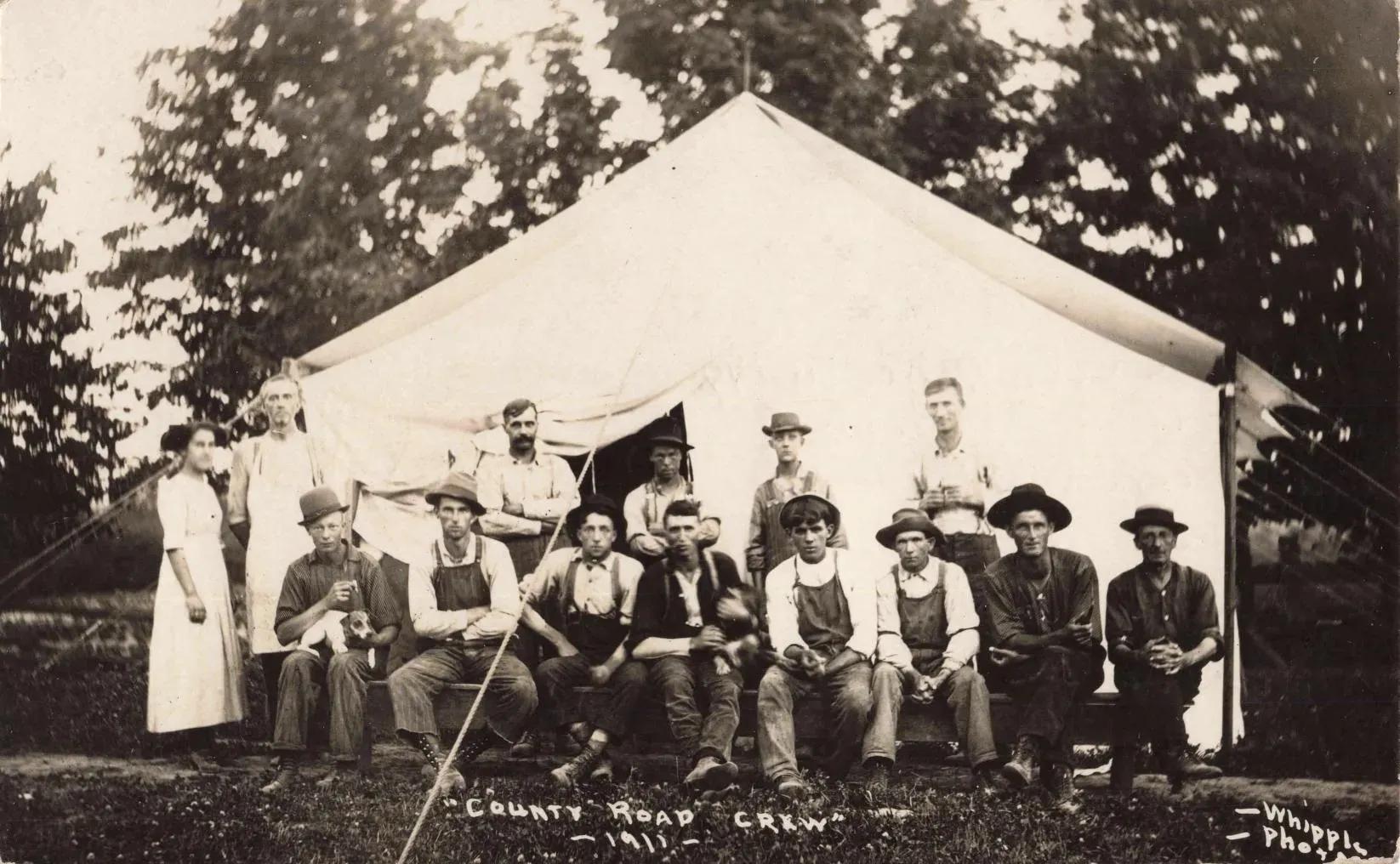
Michigan Road Crew
In the early 1800s, Michigan’s interior roads were little more than dirt paths that turned to mud after rain. Wagons, stagecoaches, and farm teams often became stuck, slowing the movement of goods and settlers across the frontier. To address this, local entrepreneurs and lawmakers embraced an early form of improved road surface known as the plank road.
The Plank Road Craze

The first formal plank road corporation chartered in Michigan marked a turning point in how people and goods moved across the state. On March 20, 1837, the Detroit, Plymouth and Ann Arbor Turnpike Corporation — also known as the Timber Road Company — received its charter from the Michigan House of Representatives. Its mandate was straightforward: build a road made of well-hewn timber between Detroit and Ann Arbor.
This plank road company was part of a broader wave that followed. Over the next two decades, more than 200 companies were authorized to build roughly 5,800 miles of plank roads across Michigan. Some stretches extended over 200 miles, such as the route from Zilwaukee to Mackinaw City via Traverse City. Others were short local connections of a mile or less in places like Sault Ste. Marie.
Plank roads were built by laying boards roughly eight feet long on log foundations, creating a wooden surface that held up better against rain and mud than native trails. Many early settlers credited these roadways with enabling travel and commercial connections between emerging towns.
The Plank Road Act

The system grew quickly, aided by legislation like the 1848 Plank Road Act. That law allowed private business owners to build and operate plank roads without a special charter, provided they met minimum road standards. As a result, the expansion of improved routes became easier and more widespread.
Though plank roads ultimately fell out of favor due to rot, maintenance costs, and the rise of railroads, their early adoption helped shape Michigan’s transportation network. Remnants of these routes underlie sections of today’s highways, and the historical choice to invest in improved roads laid the groundwork for later infrastructure.
For a deeper look at Michigan’s plank road era and its broader history, see Michigan Plank Roads Craze Covered the State in the 1800s at Michigan4You.